Tarikua Erda

 [email protected]

I am a postdoc in the finance department at NYU Stern. I study climate economics, labor, and entrepreneurship & innovation.

In September 2026, I will start as an Assistant Professor of Finance at Stern at NYU Abu Dhabi.

I have a PhD in Sustainable Development from Columbia University and a BA in Economics from Princeton University.

Download CV (Updated: July 23, 2026)

Upcoming presentations:
  • Summer 2026: NBER Summer Institute (Labor Studies)
  • Fall 2026: KU Leuven; Paris School of Economics; Uppsala University

Research

Published Work

  • Reviving Vavilov’s Vision: The Tragedy of Biodiversity Governance and Principles for Reform

    with David Bertioli, Soraya Leal-Bertioli, Charles Simpson, Scott Barrett, Peter Raven (December 2025)

    This perspective addresses two of humanity’s greatest challenges: feeding a growing population and conserving biodiversity. We begin by examining the legacy of Nikolai Vavilov, who pioneered the improvement of crops such as wheat and beans by hybridizing them with their wild relatives. This strategy used wild species biodiversity to introduce new genetic variation into crops, making them more resilient and productive. Its adoption around the world greatly increased food security and brought lasting benefits to humanity. However, since the 1990s, well-intentioned laws shifted the governance of biodiversity from a shared global resource to the sovereign control of nation states, with serious unintended consequences. These changes have disrupted the collection, preservation, exchange, and use of biodiversity, all of which are central to Vavilov’s strategy for crop improvement and to biodiversity science more broadly. Efforts at reform have been frustrated as the issues became moralized, inhibiting the open dialogue needed for change. Using foundational concepts shared by science and good governance, we propose seven empirically grounded principles for reform, to help realign biodiversity governance with its intended aims. We then suggest a framework—underpinned by global financing to protect biodiversity hotspots—that would allow the principles to work in practice. Together, these measures would create the conditions for stronger biodiversity conservation and research, agricultural development, global food security, and all the associated benefits to humanity.

    Proceedings of the National Academy of Sciences


Working Papers

  • Cleansing Floods? Creative Destruction and Government Spending after Disasters

    (2026) Previously titled "Disasters, Capital, and Productivity."

    Disasters devastate economies, yet productivity can improve in their wake. Why? Using confidential plant-level microdata from the US Census Bureau and an event study design, I trace the creative destruction process that follows large, federally declared floods. Exits are concentrated among the least productive plants, whose used machines are then acquired by high-productivity entrants. Survivors upgrade their machinery as they rebuild and see productivity gains. Federal disaster spending facilitates this process by expanding financing access for nimble young and small firms that disproportionately fuel productive reallocation. Without it, financing constraints stifle creative destruction and productivity suffers. The relative income gains from federal disaster aid generate tax revenues far exceeding the policy's upfront cost, making it both efficiency-enhancing and fiscally sound. My findings reveal a novel allocative efficiency channel through which government spending supports post-disaster recovery, with critical implications for a warming world.

    Supported by: Equitable Growth Doctoral Research Grant·Columbia Center for Political Economy Graduate Research Grant

    Selected presentations: NBER Productivity Lunch Seminar·Chicago Fed·NBER SI (Macro-Productivity & CRIW)·FSRDC Annual Conference·US Census Bureau·SOLE·LSE/Imperial Workshop on Environmental Economics·PSE*·KU Leuven*·Uppsala*


  • What's in a Mane?: Appearance Norms and Racialized Hair Bias

    with Jeffrey Shrader (2026)

    Mainstream professionalism norms favor straight hair, imposing private costs of conformity on Black individuals whose kinky hair texture deviates furthest from this standard. We conduct incentive-compatible experiments in which subjects rate headshots of hypothetical candidates for STEM jobs on professionalism, competence, and agreeableness. Relative to straightened hair, wearing one's curly/kinky hair texture carries larger penalties for Black women compared to white women, primarily for perceived professionalism and competence. For Black men, such racialized penalties are concentrated in agreeableness. Smiling attenuates racialized penalties for Black models, consistent with costly signaling of warmth to offset unfavorable priors. Leveraging the clean identification that hairstyle affords, our study speaks to a broader class of malleable identity markers that individuals may alter to conform to dominant norms but only at ongoing private cost. Because these costs recur in daily life rather than at discrete episodes like hiring, they fall largely outside the existing literature's focus, implying that current estimates understate the welfare toll of discrimination. Our findings also inform ongoing legal discourse around recognizing hair texture as a protected racial characteristic and outlawing hair-based discrimination in the U.S.

    Supported by: ISERP Seed Grant·CELSS Seed Grant

    Selected presentations: NBER Economics of Race and Stratification Workshop·WEFI Fellows Meeting


  • Employer Preferences and Job-Seeker Beliefs: Experimental Evidence from the Post-College Job Search Process

    with Laura Caron (2026)

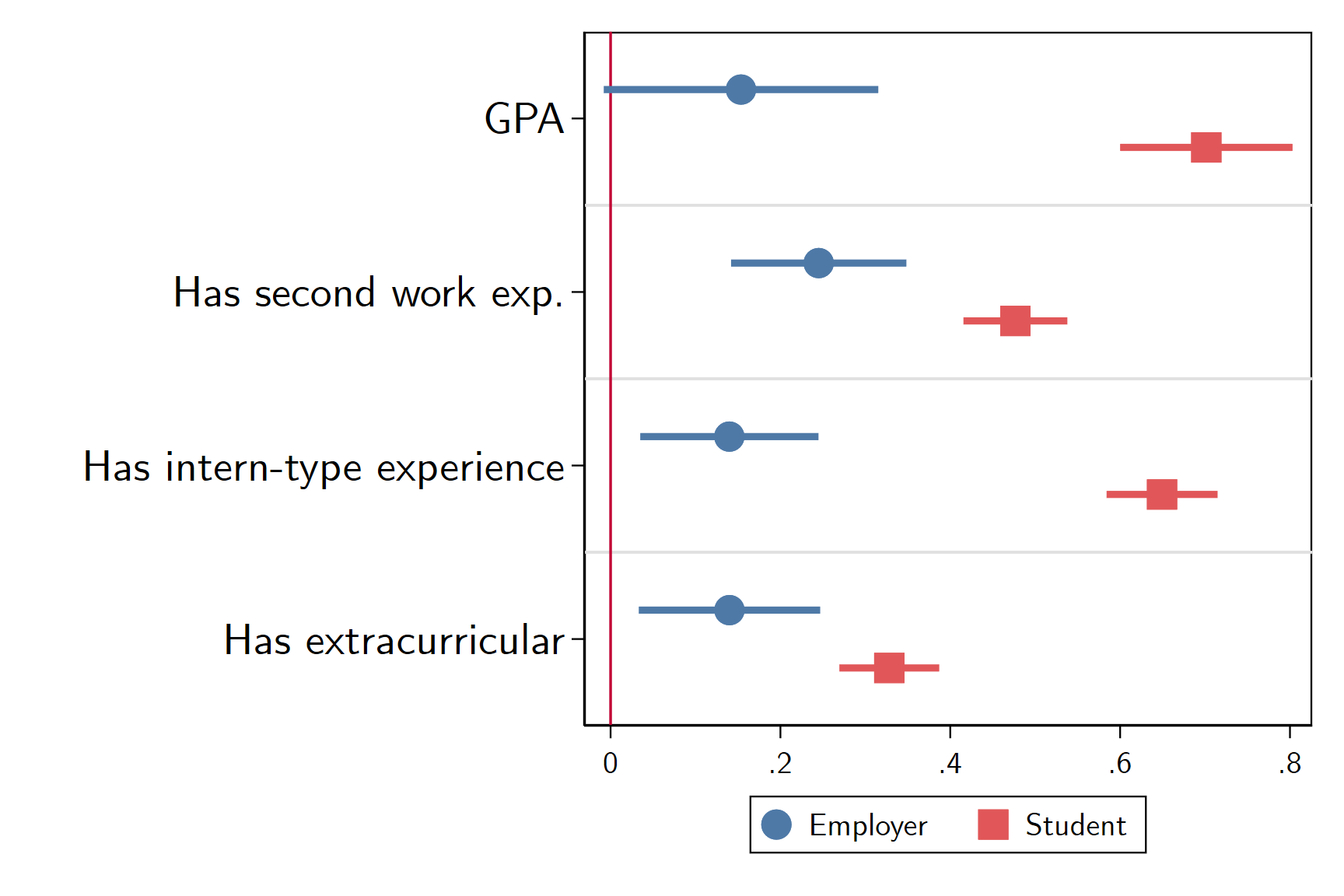
    Job seekers' beliefs about employer preferences may matter for their search behavior and outcomes, but they are poorly understood. Partnering with a large public university in the Southeastern U.S., we develop a two-sided incentivized experiment on both employers and job-seeking students to examine the nature, accuracy, and potential consequences of job seekers' beliefs. We first establish a detailed picture of what employers actually value, including underexplored elements like extracurriculars. Relative to this benchmark, students are highly misinformed about the preferences of the employers they are targeting: in particular, they overestimate the importance of professional internships while underestimating the role of work experience, extracurriculars, and GPA. Miscalibration is higher among non-white students and those with more racially-homogeneous friend groups. Inaccurate beliefs are associated with worse job outcomes, with 1 SD worse information linked to up to 4pp lower probability of having a position and $2000 lower wages for some students. Our work introduces new methodological approaches and provides evidence on employer preferences and information quality among job seekers in an understudied context, with implications for the design of interventions to reduce frictions in the job search process.

    Supported by: NSF Dissertation Grant in Economics (SES-2215219)·RSF Dissertation Grant

    Selected presentations: AFE·APPAM·MDRC·SWEET·NBER Summer Institute (Labor Studies)*

* scheduled    presented by coauthor


Work in Progress

  • Data Capital and Innovation: Evidence from Connected Devices (Draft available upon request)

    with Ryan Gilland and Ben Lahey

    Consumer data is a valuable form of intangible capital, but goes unmeasured in standard firm-level datasets. Applying natural language processing to the user manuals of the universe of wireless devices sold in the U.S., we construct the first measure of firms' data capital: each firm's portfolio of connected “smart” devices that collect and transmit user data through apps, accounts, and cloud servers. Data-capable public firms are large, highly R&D-intensive, and have dominated patenting in machine learning and AI, domains where data is a core input. Using a triple-difference design around the European General Data Protection Regulation's restrictions on personal data, we find substantial declines in R&D investment and patenting among consumer-facing data-capable firms, with innovation slowdowns primarily concentrated in data-intensive AI domains. Financial markets durably marked down the valuations for GDPR-exposed firms with larger smart consumer gadget portfolios, reflecting the decline in expected future rents from personal data. Our approach offers a new, scalable measure of data capital with direct implications for firm performance and innovation in the AI era.

    Selected presentations: Economics of Strategy Workshop


Wondering how to pronounce my name? It is 'Taa-ree-kwa'. I am always happy to clarify, so please feel free to ask :)